
ChatGPT Wallet: how it works and who can use it
/ ChatGPT Wallet lets OpenAI's dots agents buy things for you with a stand-in card number and a Face ID check. Here's how it works, who gets it and the limits.
by Hozefa Khety
· 6 min read
OpenAI has launched ChatGPT Wallet, a way for its AI agents to pay for things on your behalf. It began rolling out on Friday, November 13, 2026, inside dots, the personal agents OpenAI introduced at its developer conference in September. For now it is limited to ChatGPT Pro subscribers in the US.
The pitch is simple: you save a credit card once, ask your dot to find and buy something, and approve the final checkout with Face ID or a fingerprint. OpenAI says the agent and the store never see your real card number. Here is how it works, who can use it, and what to watch out for.
What is ChatGPT Wallet?
ChatGPT Wallet stores a payment card so a dot can complete purchases for you. OpenAI built it with American Express, Mastercard and Visa, and calls it "the first wallet that lets agents pay without access to users' actual card details and that requires a security check for every purchase."
A dot is OpenAI's name for a personal AI agent: a helper you can ask to do multi-step jobs, such as researching a gift or booking a hotel. Until now a dot could find products but you still had to check out yourself. Wallet closes that last step. OpenAI's own examples are prompts like "Help me find a new sweater" and "Book me a hotel for my trip to Chicago next weekend."
How a purchase works
According to OpenAI's help center, the flow has three parts. First you add a card, either by asking your dot "Help me add a card to Wallet" or from Settings, then Wallet on mobile. Card details go into a secure form, never into the chat, and your bank may ask you to verify the card with a code or in its app.
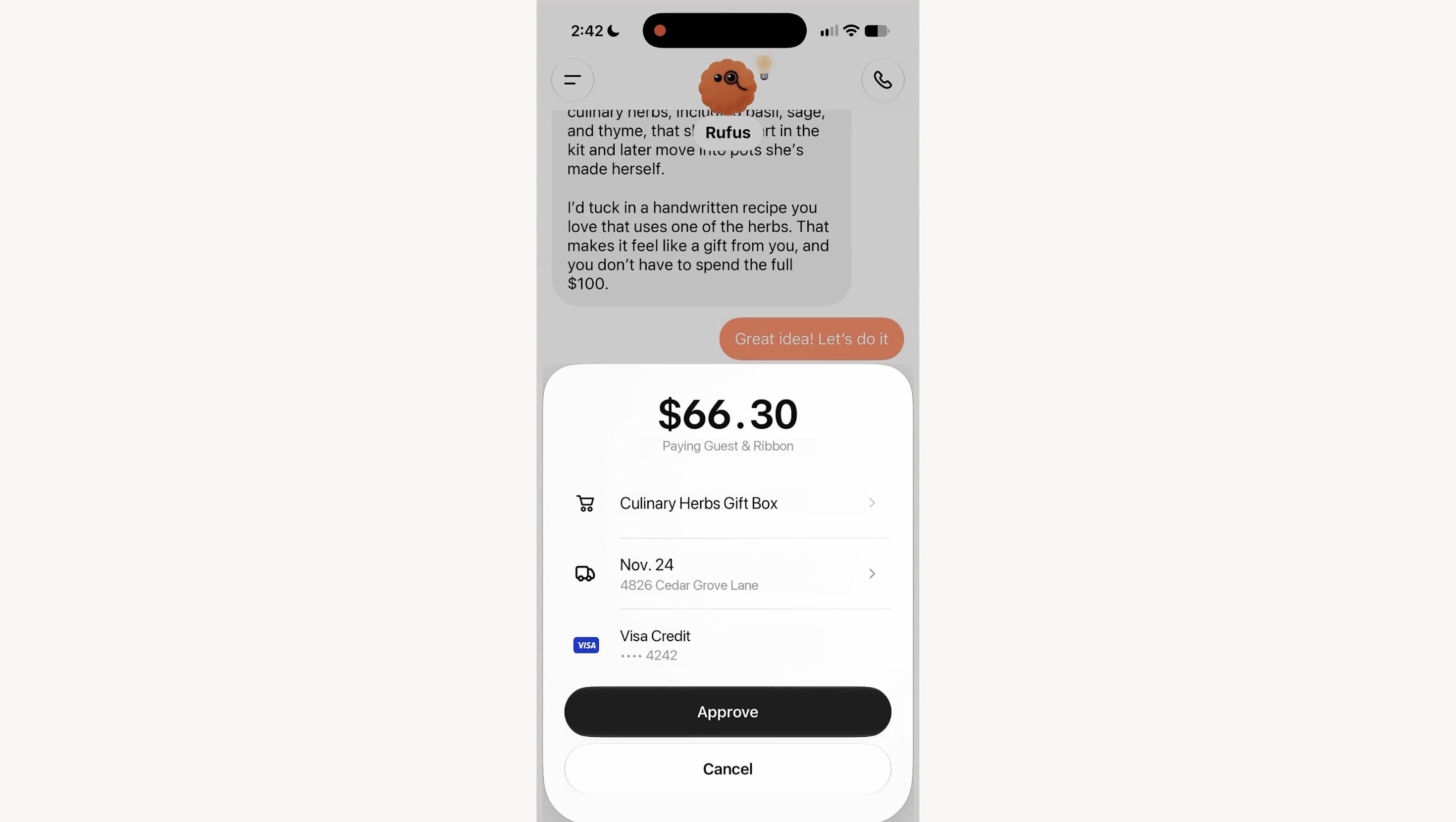
Second, when your dot is ready to check out, it shows a purchase request with the merchant, the items, the total, the card and any shipping or recurring-payment terms. You tap Approve and confirm with Face ID, Touch ID or a similar biometric check. If your current device cannot do that, a link or QR code lets you approve on a supported phone signed in to the same account.
Third, the card network creates a payment token, a stand-in card number, security code and expiry date, and your dot uses it to finish checkout. The charge lands on your real card, but the number the store sees, and the one on your receipt, may differ from the one printed on your card. OpenAI compares this to how tap-to-pay and phone wallets already work.
Who can use ChatGPT Wallet
At launch you need all of the following, according to OpenAI's help center and Wallet terms (checked November 13, 2026, 21:15 UTC):
A ChatGPT Pro subscription. A dot already set up, since Wallet only works in dot conversations, not in regular Chat, Work or standalone Codex threads. To be 18 or older, living in the US, with a US billing address. And an eligible US-issued American Express, Chase, Mastercard or Visa credit card.
Debit cards are not supported, and neither are virtual cards at launch. For a Chase card you must be the primary cardholder, not an authorized user, and you approve the link in the Chase mobile app. OpenAI says it will expand availability after learning from early use, but it has not given dates or named other countries.
How much does it cost?
Wallet itself has no extra fee, but you need ChatGPT Pro, which OpenAI sells in three monthly tiers: Pro 100 at $100, Pro 200 at $200 and Pro 500 at $500 a month (OpenAI help center, checked November 13, 2026, 21:15 UTC). Plus ($20) and Go ($8) subscribers and free users do not get Wallet yet.
OpenAI is not taking a cut of purchases for now, CNBC reports. Chaya Nayak, who leads monetization and payments product at OpenAI, told CNBC the goal is to "start building out a really great foundation that's safe and easy to use."
Is ChatGPT Wallet safe?
OpenAI's main safety claims are that your real card details are never shared with the agent or the store, that every purchase needs your biometric approval, and that each approval creates a record of exactly what you authorized. You also keep your card's normal rewards and its protections for eligible disputes, for example if an item arrives broken.
There are limits to know about. OpenAI's own Wallet terms warn that "AI systems can make mistakes" and say not to approve a purchase unless the details are correct. A "ready to check out" message only means your approval went through, not that the store accepted the order, so check for a merchant confirmation before trying again. And if you agree to a subscription, the store may keep the payment credential and charge it again, which you have to cancel with the store, not with OpenAI.
Returns, refunds and order problems go to the store, which keeps control of pricing, delivery and customer service. Declined or unrecognized charges go to your card issuer. OpenAI says to never paste a card number, security code or bank verification code into a chat or support message.
Will it work at every store?
No. OpenAI says some websites may block agent purchases, sometimes by accident, and that stores' fraud systems may decline legitimate agent orders. Some companies block AI agents on purpose: CNBC notes that Amazon prevents agents from buying on its platform, and United Airlines said this week it will block agents from booking tickets in its systems.
To help stores get ready, OpenAI published a Commerce Partner Playbook. It tells businesses to let signed ChatGPT agent traffic through their firewalls using a standard called Web Bot Auth, upload product feeds with current prices, and work with payment and fraud partners. OpenAI says it is working with fraud-prevention firms Forter, Riskified, Sardine and Signifyd, and payment providers Adyen, Checkout.com and Stripe.
What comes next
OpenAI says that over time it expects people to hand purchases entirely to their agent within set rules, such as spending limits, purchase categories or time periods, and pre-approve them with extra safeguards. That is not available today: every purchase still needs your approval.
This is also OpenAI's second try at shopping inside ChatGPT. CNBC reports that an earlier Instant Checkout feature launched last fall was quickly dropped in favour of a revamped shopping experience in March. With more than 1.2 billion weekly ChatGPT users, OpenAI's slow, Pro-only start gives banks and stores time to adapt before any wider rollout.
Should you try it?
If you already pay for ChatGPT Pro in the US and use a dot for research or trip planning, Wallet removes the step of typing your card details into each site, and the biometric check before every purchase is a sensible guardrail. Start with small, low-risk orders, read every purchase request carefully, and confirm with the store that the order went through.
If you are outside the US, on Plus or Go, or only have a debit card, there is nothing to set up yet. Watch for OpenAI to widen access once it has worked through store compatibility and fraud declines.
See more of The Threshold on Google
Add us as a preferred source to see more of our stories in your Top Stories.
Frequently asked questions
What is ChatGPT Wallet?
ChatGPT Wallet is OpenAI's payment feature that lets your dot, a personal ChatGPT agent, buy things for you. You save a credit card once and approve each purchase with Face ID or a fingerprint, and the agent pays with a token instead of your real card number.
When did ChatGPT Wallet launch?
OpenAI announced ChatGPT Wallet on November 13, 2026, and it began rolling out that day to ChatGPT Pro subscribers in the US.
Who can use ChatGPT Wallet?
At launch, ChatGPT Pro subscribers aged 18 or older who live in the US, have a US billing address and an eligible US-issued American Express, Chase, Mastercard or Visa credit card. You also need a dot set up, because Wallet only works in dot conversations.
How much does ChatGPT Wallet cost?
Wallet has no separate fee, but it requires ChatGPT Pro, which costs $100, $200 or $500 a month depending on the tier. CNBC reports OpenAI is not taking a cut of purchases for now.
Is ChatGPT Wallet available outside the US?
Not yet. OpenAI says it will expand availability after learning from early use, but it has not announced dates or other countries.
Can I use a debit card with ChatGPT Wallet?
No. OpenAI's help center says debit cards are not supported, and virtual cards are not supported at launch either. You need an eligible US-issued credit card.
Does the AI agent see my card number?
No, according to OpenAI. After you approve a purchase, the card network issues a payment token with a stand-in card number, security code and expiry date, so neither the agent nor the store gets your actual card details.
Can ChatGPT Wallet buy things without asking me?
Not today. Every purchase needs your approval with a biometric check. OpenAI says it expects to let users pre-approve purchases within spending limits, categories or time periods in the future.